|
THE UNITED REPUBLIC OF TANZANIA:
A country of contrasting beauty, a vast myriad of landscape intermingled with wildlife and people. From the coastline of exotic Spice Islands, to snow capped peaks on the equator, the boundless plains of teeming wildlife and the ancient cradle of humankind. Tanzania is the largest of East African Nations. Over a quarter of Tanzania contains the continents largest game reserves, control areas and national parks. To the north are the endless plains of the Serengeti, home to over three million animals. Further east lies the Eighth wonder of the World, a caldera of unsurpassed beauty, the Ngorongoro crater. In the South is the largest and most remote wildlife sanctuary, the Selous Game reserve.
Tanzania has more inland water that any other African country. On its western border, Lake Tanganyika is the deepest and longest freshwater lake in Africa. Flowing to the Indian ocean from a major river system is the grand Rufiji, and in the northwest, Lake Victoria, the worlds second largest fresh water lake.
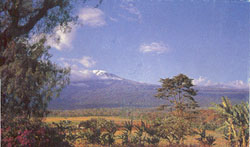
A nation of craters and mountains, both extinct and active, but above all, the country of majestic Mount Kilimanjaro. Rising out of the dusty bush of the northern Maasai steppe, it is the highest mountain in Africa peaking at 5,895m
|
|
Tarangire National Park:
This (2600sq. km) Park is second only to the Ngorongoro Crater, Tarangire National Parks has the highest concentration of wildlife during the dry season and is the most accessible and beautiful parks on the northern circuit. The Tarangire River, which flows through the length of the park, offers the only permanent source of water for wildlife. Tarangire is also the only northern park where one can see large concentrations of Elephant year round. It is known for its diverse ecology of river floodplains, wetlands, rolling hills, rocky outcrops and Acacia woodlands. A few Resident animals to Tarangire are the oryx, Greater and Lesser kudu, lion, leopard, and cheetah and well over 550 species of birds.
Ngorongoro Crater - The Eigth Wonder of the World.
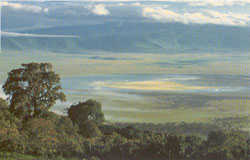
Ngorongoro Conservation Area Authority (8300sq.km) This unique place must be seen to be believed. The Ngorongoro Crater (a collapsed volcanic caldera), one of several in the area, covers 250sq.kms and is 611m deep. The crater is often referred to as the 8th Wonder of the World and has been designated as a World Heritage Site. The crater floor contains alkaline and fresh water lakes and teems with large carnivores, herbivores, primates and birds. It also boasts one of the last viable populations of the nearly extinct Black Rhinoceros and the highest destiny of lion and Spotted hyena in Africa.
The Ngorongoro Conservation Area includes the world-famous archeological sites of Laetoli, with its fossil footprints of animals and ancestral humans who walked the earth 3.6million years ago, and Olduvai Gorge, which continues to yield a remarkable record of human evolution that began some 2 million years ago. Laetoli has been officially closed to the public for reasons of conservation. However, one can visit the museuam at Olduvai and, in the company of Antiquities Staff, visit some of its archeological sites made famous by Louis and Mary Leakeys remarkable discoveries.
SERENGETI NATIONAL PARK.
Serengeti National Park covers an area of (15,000sq.km) The worlds most famous game park is unrivaled anywhere for its seasonally shifting concentrations of herbivores. Nearly 1.5 million Wildebeest with hundreds of thousands of gazelle and zebra complete a cyclical annual migration within the ecosystem. Little history dating from the German colonial times is available on this magnificent park.
The area was first opened up in the early 1920s by professional hunters and was not until the lates that the central part of the park was made designated as a game reserve. It was a closed game reserve in 1950 in which certain species were totally protected. Serengeti derives its name from the Maasai word Siringit for the endless short and long-grass plains that also contain open Acacia woodlands, rivers, rocky outcrops, and the central ranges of mountains. The Serengeti is well know for its large prides of lion, the wildebeest. The wealth of bird-life is also of special interest, with over 400 species of birds having been recorded, some of them Eurasian migrants.
|
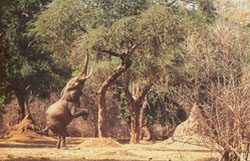 Tarangire Elephant.
Tarangire National Park covers an area of (2600sq. km) Second only to the Ngorongoro Crater, Tarangire National Parks has the highest concentration of wildlife during the dry season and is the most accessible and beautiful parks on the northern circuit. The Tarangire River, which flows through the length of the park, offers the only permanent source of water for wildlife.
Tarangire is also the only northern park where one can see large concentrations of Elephant year round. It is known for its diverse ecology of river floodplains, wetlands, rolling hills, rocky outcrops and Acacia woodlands. A few Resident animals to Tarangire are the oryx, Greater and Lesser kudu, lion, leopard, and cheetah and well over 550 species of birds |